Textalk POD Solution: A 3-in-1 POD Production Line Built for Print on Demand Mass Production
Textalk POD (Print on Demand) Solution is designed for one type of buyer: Print on demand factories and production teams who need repeatable output at industrial pace – without adding operator headcount every time volume spikes.
Instead of treating pretreatment, white underbase, and color as separate “mini-departments,” Textalk POD Solution organizes them as one continuous line so you can move from file to finished garment with fewer handoffs and fewer variables to manage. (For the full package scope, software stack, included components, and service/training, see Fluxmall’s product page: https://fluxmall.com/en/product/textalk-pod-solution/.)
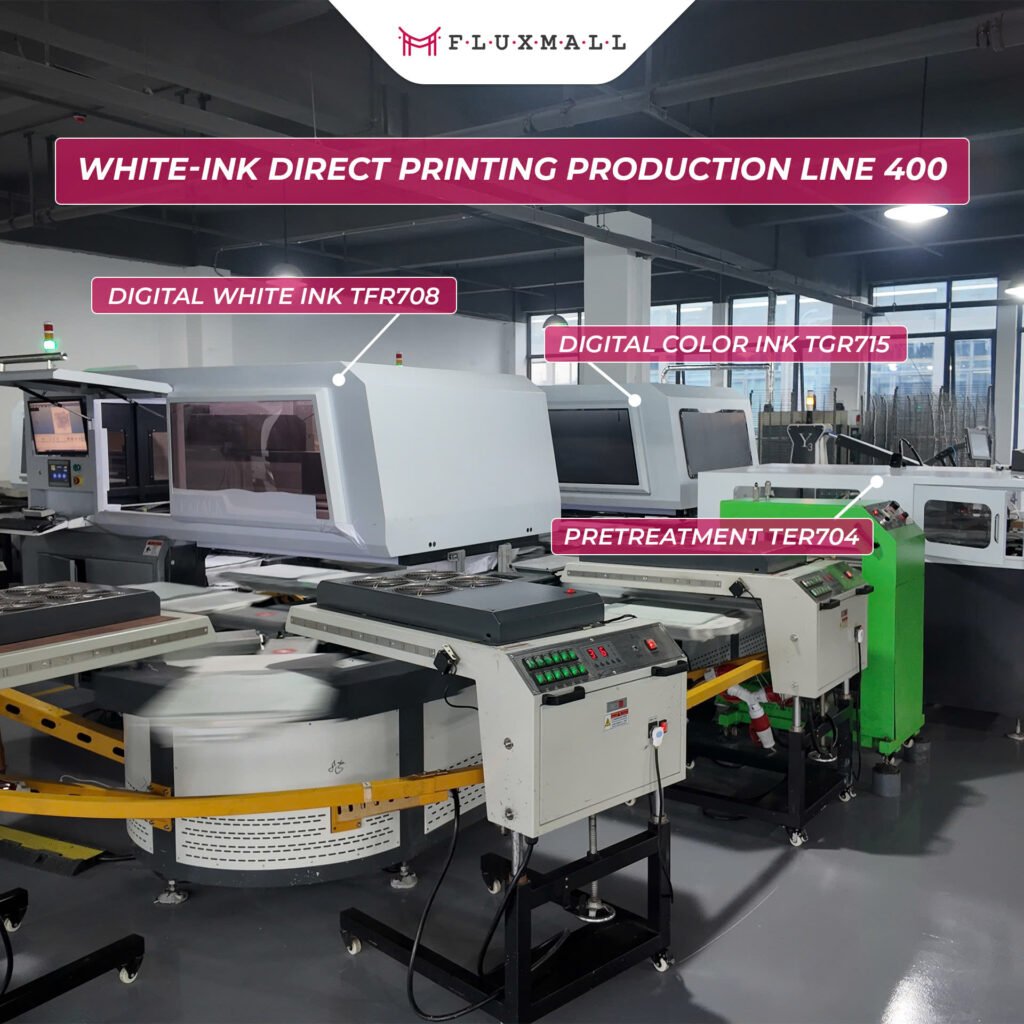
3-in-1 Print on Demand printer: What Textalk POD Solution is (in production terms)
A 3-in-1 Print on Demand printer setup, in this context, isn’t a single print engine. It’s an integrated production concept built around three digital direct-injection steps in one workflow, so each stage is optimized for what it must do, while the line stays continuous. Fluxmall describes Textalk POD Solution as a POD-focused digital textile solution that uses three digital direct injection in the workflow and supports a broad color range using a multi-color system plus white.
What makes it “production” isn’t only print quality, it’s the operational package around it. Fluxmall lists the solution as including neoStampa RIP and MES POD Automation Software, plus on-site installation by Textalk-certified technicians and print training.
If your factory already runs shift-based lines, that matters: the more the workflow is standardized through software, the less you rely on “expert-only” tribal knowledge to keep output stable.
Pretreatment + white + color in one line: How the 3-in-1 workflow works
The simplest way to understand the system is this: pretreat → white → color, built as one linked process.
Fluxmall’s demo content describes the concept as moving “from file to garment in one pass,” with pretreatment, white base, and color in one line, and emphasizes “no screens” in the process.
What each stage is responsible for
Pretreatment stage
This prepares the garment surface so ink lays down consistently and holds up better in production, especially on more demanding garments or when consistency matters across long runs. (If you want to align chemistry and handling, Fluxmall’s Textalk Pretreatment page gives the intended role of pretreatment in improving ink adhesion and print quality: https://fluxmall.com/en/product/textalk-pretreatment/.)
White stage
White is the “production equalizer” for dark garments. In real POD lines, white is often where variability appears first (coverage, hand feel, curing sensitivity). The line concept isolates this stage so you can keep it controlled rather than improvising under pressure.
Color stage
Fluxmall highlights the solution’s ability to balance inks and produce a broad range of colors, describing a 6-color system (C, M, Y, K, R, G) plus white for vivid, accurate output.
The practical takeaway: when pretreatment, white, and color are treated as one controlled sequence, you reduce the “randomness” that causes rework—marks, uneven underbase, and inconsistent visual output.
Industrial DTG POD solution: Throughput, consistency, and labor advantages
An industrial DTG Print on Demand solution should be evaluated by one KPI: finished, shippable pieces per hour, not peak print speed.
Textalk’s positioning for this line is clearly production-oriented. Fluxmall’s 3-in-1 demo content emphasizes operational efficiency, stating the system can run stably with two operators in the showcased configuration.
Why factories adopt a line approach (instead of “adding DTG”)
Throughput becomes a workflow outcome, not a single-machine promise
When jobs move as a sequence, you can plan staffing, staging, and curing with fewer surprises. That’s what keeps output stable across shifts.
Consistency improves because there are fewer handoffs
Every handoff is a chance for variation: different pretreat technique, different dwell time, different judgment calls. Inline design reduces those “human variation points.”
Labor efficiency comes from simplification, not squeezing operators
A common reason POD lines miss targets is that labor grows with volume. A line approach aims to keep labor flatter as you scale output.
If you’re building a risk-managed production plan, support is not optional. Fluxmall’s support page describes near real-time technical support availability and a team trained by manufacturers, which is exactly what production managers want when a line is on the clock. https://fluxmall.com/en/support/
POD production line: Ideal use cases where the system fits best
A POD production line like this makes the most sense when you recognize your orders are already “industrial”, even if the business model is called Print on Demand.
1) Marketplace and brand fulfillment with mixed SKUs
If your daily work is a blend of:
- frequent artwork changes,
- many small batches,
- short SLAs, you need a line that stays predictable even when the order mix is chaotic.
2) Dark-garment heavy programs
Dark garments usually multiply process risk (underbase, pretreat sensitivity, curing). A line that formalizes pretreat + white + color helps reduce reprints that silently destroy capacity.
3) Factories expanding into digital without abandoning production discipline
If you already run lean workflows—stations, takt thinking, shift handover, QC checkpoints—Textalk POD Solution is aimed at complementing that mindset rather than replacing it with “printer-centric” thinking.
For production teams that also compare alternatives, Fluxmall’s “Industrial DTG Printers” category is useful context for what a more traditional industrial DTG route looks like versus an integrated POD line approach: https://fluxmall.com/en/catalog/dtg/dtg-printers/industrial-dtg-printers/
Print on demand mass production: How to plan the upgrade for stability
Print on demand mass production fails when you scale prints but don’t scale the workflow. Here’s a practical, production-manager way to plan the upgrade.
Start with the line constraint, not the printer
Before you finalize anything, define your target output in “finished pieces per hour” and ask: where does finishing become the constraint?
In most POD facilities, the constraint is usually one of:
- staging and handling (garments don’t arrive ready at the right time),
- curing/finishing capacity,
- QC/reprint loops.
Confirm layout and space needs early
Inline systems are sensitive to layout. The goal is a clean flow:
inbound blanks → line processing → curing/finish → QC/pack-out.
If operators have to cross paths or backtrack, you’ll feel it every shift. Even small extra steps become huge at mass volume.
Standardize software and job control
Fluxmall lists neoStampa RIP and MES POD Automation Software as part of the Textalk POD Solution package.
In production, that matters because software is how you keep:
- job routing consistent,
- color handling predictable,
- repeatability stable across operators and shifts.
If you want to understand why neoStampa is commonly positioned as a color management and optimization layer in digital print workflows, Fluxmall’s neoStampa overview is a helpful reference: https://fluxmall.com/en/power-your-printer-with-neostampa-rip-software/
Textalk POD Solution: Next steps for a demo and quote (what to bring)
A good demo shouldn’t be a “best-case sample.” It should look like your real day.
Fluxmall’s Textalk demo booking flow explicitly encourages printing your own artwork and learning RIP operation and cost calculation during the session—exactly what production buyers need before signing off on a line decision. https://fluxmall.com/vi/dat-hen/demo-truc-tuyen-textalk/
To get a quote that matches reality, prepare:
- your monthly volume target and peak-day expectations,
- your garment mix (especially dark/light ratio),
- 2–3 representative artworks (solid-heavy + gradient/detail),
- your shift model and staffing constraints,
- your quality requirements (hand feel, durability, reject tolerance).
If you’re making an industrial upgrade, you’re not just buying equipment – you’re buying production behavior. The right next step is a demo that measures workflow repeatability, not just print appearance.
And if you want a quick reality-check on why service matters in industrial printing decisions, Fluxmall’s after-sales article frames support as a key factor in keeping industrial operations running smoothly: https://fluxmall.com/en/why-after-sales-support-is-crucial-in-industrial-textile-printing/